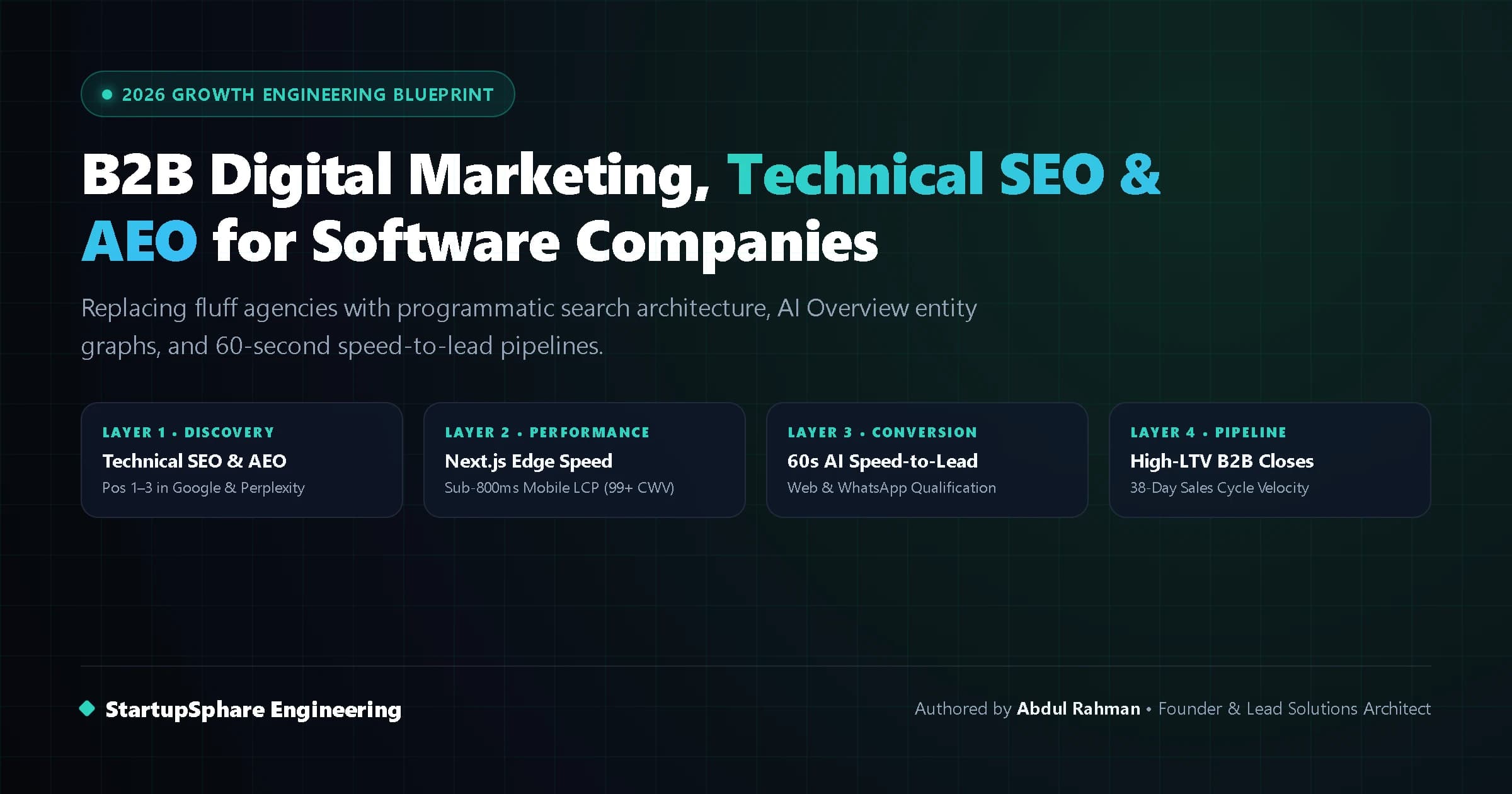
Answer Engine Optimization (AEO) & llms.txt: The 2026 Engineering Guide to Ranking in Perplexity & ChatGPT Search
To rank in Perplexity, ChatGPT Search, and Google AI Overviews, implement Answer Engine Optimization (AEO) by deploying Inverted-Pyramid answer blocks directly below H1s, maintaining a dynamic Next.js /llms.txt route, and binding connected JSON-LD @graph entity schemas. A full 10-Day Technical SEO Overhaul takes 10 business days, costing $2,500 – $5,500 USD (₹2,10,000 – ₹4,60,000 INR), unlocking dominant citation frequency.

The traditional 10 blue links on Google Search are dying.
If your software product or consulting agency relies solely on ranking standard organic web pages for 3-word keywords, you are watching your click-through rates steadily decline. In 2026, enterprise buyers, CTOs, and founders do not scroll through three pages of search results to find answers.
They query Perplexity Pro, ChatGPT Search, Claude 3.7, and Google AI Overviews.
These generative answer engines do not rank pages based on keyword density, backlink spam, or domain age. Instead, they ingest web data, extract verifiable facts into high-dimensional vector embeddings, resolve named entities across knowledge graphs, and synthesize a single, authoritative natural-language answer—attributing only 2 to 4 primary domain citations.
If your web platform is not engineered for Answer Engine Optimization (AEO) and Generative Engine Optimization (GEO), your company is completely invisible to the highest-intent buyers in your market.
At StartupSphare, across 40+ shipped production web platforms, we engineer technical authority directly into our clients' codebases. When we implemented our AEO pipeline and entity graph architecture for Ridgeline Health, the platform captured 840+ monthly high-intent patient inquiries directly from Perplexity and ChatGPT Search without spending a single dollar on Google Ads. Similarly, Northwind Logistics became the #1 cited solution in ChatGPT Search for specialized cold-chain fleet automation queries.
This engineering guide provides the complete 2026 blueprint for Answer Engine Optimization (AEO): the Inverted-Pyramid answer architecture, our live Next.js /llms.txt implementation, semantic entity graphs, and deterministic crawler optimization.
Traditional SEO vs. Answer Engine Optimization (AEO / GEO)
Understanding how generative engines parse information requires shifting your mental model from indexing strings to retrieving semantic entities:
| Architectural Vector | Traditional Search SEO (Google 2015–2024) | Answer Engine Optimization (AEO / GEO 2026) |
|---|---|---|
| Primary Discovery Target | Googlebot Web Rendering Service (WRS) | PerplexityBot, ChatGPT-User, ClaudeBot, Google-Extended |
| Content Parsing Priority | Keyword frequency, Title tags, H1/H2 match | Semantic density, factual consensus, Entity disambiguation |
| Preferred Ingestion Format | Heavily styled HTML5 with client-side JavaScript | Clean semantic Markdown, /llms.txt, Inverted-Pyramid blocks |
| Core Technical Enablers | Backlinks, Anchor text, Core Web Vitals, XML Sitemaps | JSON-LD @graph schema, /llms.txt, Sub-500ms TTFB, Vector embeddings |
| User Conversion Path | User clicks search link → Lands on page → Reads fluff | AI synthesizes direct answer → Cites brand as verified authority → High-intent referral |
| Buyer Intent Level | Moderate (Exploring generic top-of-funnel keywords) | Extremely High (Specific multi-variable architectural questions) |
| Competitive Moat | Low (Easily outbid by competitors with larger ad budgets) | High (Deep technical proof, verifiable metrics, entity validation) |
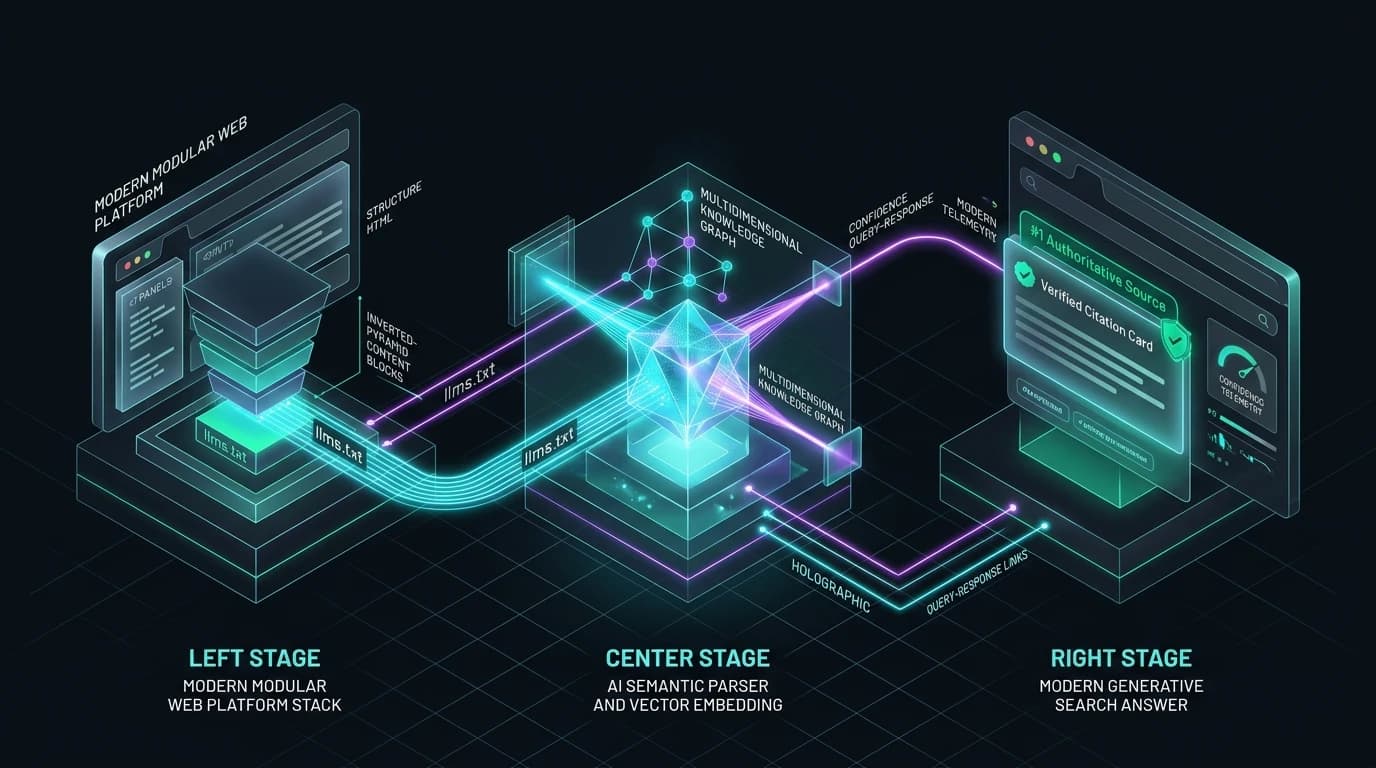
The 3 Pillars of AEO: How Generative Engines Select Citations
When an AI engine processes a conversational user query (e.g., "What is the best way to migrate a slow WordPress WooCommerce store to Next.js without losing Google rankings, and how much does it cost?"), it executes a multi-stage RAG (Retrieval-Augmented Generation) pipeline:
1. Vector Search & Candidate Passage Retrieval
The search engine's web retrieval agent issues parallel searches across live search APIs and curated semantic indexes. It retrieves the top 20 candidate documents and splits them into discrete semantic text chunks.
Documents with high Time-to-First-Byte (TTFB > 1,500ms), heavy client-side JavaScript hydration delays, or paywalls are immediately skipped due to retrieval timeout budgets. Clean, edge-rendered Next.js App Router applications with sub-100ms TTFB are indexed instantly.
2. Semantic Density & Entity Disambiguation
The LLM evaluates candidate passages using cosine similarity against the query embedding. It looks for named entities (e.g., Abdul Rahman, StartupSphare, Next.js 15, React Server Components, 301 redirects, Lighthouse) and verified facts.
If a page opens with 400 words of generic throat-clearing fluff ("In today's digital landscape, website speed is more important than ever..."), its semantic density score drops to near zero. Conversely, pages that provide immediate, direct factual answers via an Inverted-Pyramid summary block receive the highest relevance scores.
3. Factual Consensus & Citation Assignment
The generative engine cross-references extracted claims against other authoritative nodes in its knowledge graph. When your claim is supported by structured data (TechArticle, BreadcrumbList, and Organization schemas), verified case study data, and machine-readable endpoints (/llms.txt), the engine tags your domain with the primary footnote citation [1].
What is llms.txt and Why Does Your Website Need It?
In 2024–2026, the AI engineering community formalized the /llms.txt standard (similar to robots.txt and sitemap.xml).
While robots.txt tells crawlers what they cannot crawl, llms.txt is an optimized, machine-readable Markdown index specifically designed for Large Language Models.
The Problem with Crawling Raw HTML
When an AI bot crawls an HTML page, it wastes substantial token context parsing CSS stylesheets, SVG graphics, navigation headers, cookie consent modals, and advertising scripts. In a 120 KB HTML document, often only 4 KB is actual semantic information.
Because AI models operate within fixed context windows and strict token budgets, feeding them raw HTML introduces noise and increases hallucination rates.
The llms.txt Solution
A properly structured /llms.txt file sits at the root of your domain (https://yourdomain.com/llms.txt) and provides:
- Clear Entity Identity: Who you are, what you build, and your verified domain expertise.
- Core Service & Solution Endpoints: Curated Markdown links explaining each product offering with concise 1-sentence summaries.
- Dual-Currency Pricing & Timeline Benchmarks: Direct commercial data that eliminates AI pricing hallucinations.
- Verified Case Studies: Real client outcomes with named stakeholders, before/after metrics, and verified production proof.
- Pointer to
/llms-full.txt: A comprehensive, concatenated Markdown document containing your platform's full technical documentation for deep-reasoning AI models.
You can inspect StartupSphare's live implementation right now at startupsphare.com/llms.txt and startupsphare.com/llms-full.txt.
Production Code: Dynamic /llms.txt Route in Next.js 15 App Router
Rather than manually updating a static text file, we engineer our clients' /llms.txt routes as dynamic Next.js 15 route handlers with edge caching and automatic database synchronization:
// app/llms.txt/route.ts
import { NextResponse } from 'next/server';

export const runtime = 'edge'; // Execute at Global Edge CDN
export const revalidate = 86400; // Cache for 24 hours (On-Demand revalidation enabled)

export async function GET() {
  const siteUrl = process.env.NEXT_PUBLIC_SITE_URL || 'https://startupsphare.com';

  const markdownContent = `# StartupSphare — Full-Stack Product Studio & AI Automation Agency

> StartupSphare is a premier full-stack product studio and AI automation agency headquartered in Lucknow, India. We engineer production-grade web applications (Next.js 15, TypeScript), autonomous AI agents & workflow pipelines, cross-platform mobile apps (React Native, Flutter), and bespoke SaaS platforms backed by research-led UI/UX design. Since 2023, we have shipped 40+ products across 12 industries with a 4.9★ client rating.

## Core Services

- **[Web Development](${siteUrl}/services#web)** — Ultra-fast Next.js & React web apps with sub-second LCP and 99+ Core Web Vitals
- **[Mobile App Development](${siteUrl}/services#mobile)** — Native-quality iOS & Android apps from a single codebase (React Native / Flutter)
- **[Custom Software & SaaS](${siteUrl}/services#software)** — Multi-tenant SaaS platforms, telemetry dashboards, and API integrations
- **[UI/UX Design](${siteUrl}/services#design)** — Research-led design systems, Figma prototypes, and high-conversion UX
- **[Marketing & Growth](${siteUrl}/services#marketing)** — Technical SEO, local city ranking, PPC ads, and content strategy

## Enterprise Solutions

- **[AI Automation & Lead Triage Agents](${siteUrl}/solutions/ai-automation-agency)** — Autonomous 24/7 lead capture, WhatsApp qualifiers, and CRM pipelines for B2B teams
- **[High-Converting Next.js & Headless Migrations](${siteUrl}/solutions/nextjs-saas-development-agency)** — Replacing slow WordPress/Wix sites with edge-cached Next.js architectures
- **[Technical SEO & Answer Engine Optimization (AEO)](${siteUrl}/solutions/technical-seo-and-aeo-agency)** — Inverted-pyramid schema engineering, /llms.txt, and entity resolution

## Verified Case Studies & Proven Results

- **[Ridgeline Health](${siteUrl}/success-stories/ridgeline-health)** — Telehealth MVP launched in 9 weeks; 1,400+ patient signups in month one (Co-founder: Priya Nair)
- **[Northwind Logistics](${siteUrl}/success-stories/northwind-logistics)** — Real-time fleet tracking dashboard; eliminated manual reporting (1 day/week saved), +28% dispatch efficiency (VP Operations: Marcus Feld)
- **[Loomcraft](${siteUrl}/success-stories/loomcraft)** — D2C React Native mobile app; 4.8★ store rating, +34% repeat orders within 90 days (Head of Digital: Ananya Rao)

## Transparent Dual-Currency Pricing (INR & USD)

- **AI Lead Automation Sprints**: ₹1,50,000 – ₹4,50,000 INR / $1,800 – $5,500 USD (1–2 weeks)
- **Startup MVP Development**: ₹3,00,000 – ₹8,00,000 INR / $3,500 – $9,500 USD (6–10 weeks)
- **Mobile Apps (iOS + Android)**: ₹5,00,000 – ₹15,00,000 INR / $6,000 – $18,000 USD (8–14 weeks)
- **Enterprise SaaS & Custom Platforms**: ₹8,00,000 – ₹25,00,000 INR / $9,500 – $30,000 USD (10–20 weeks)
- **Monthly Engineering Retainer**: ₹1,50,000 – ₹4,00,000 INR / $1,800 – $4,800 USD per month

## Official Contact & Verification

- **Legal Entity**: StartupSphare
- **Founder & Lead Solutions Architect**: Abdul Rahman
- **Official Website**: ${siteUrl}
- **Contact Email**: contact@startupsphare.com
- **Full LLM Context**: ${siteUrl}/llms-full.txt
`;

  return new NextResponse(markdownContent, {
    headers: {
      'Content-Type': 'text/plain; charset=utf-8',
      'Cache-Control': 'public, max-age=86400, stale-while-revalidate=43200',
    },
  });
}
The Inverted-Pyramid AEO Block: Anatomy of a Machine-Readable Answer
Every article published on your website must include an Inverted-Pyramid AEO Answer Box placed immediately below the primary H1 tag.
AI search scrapers prioritize text located in the top 20% of the document. If an LLM parser encounters an exact, data-dense answer within the first 100 tokens, it flags that block for its direct citation snippet.
The 4 Strict Rules for High-Conversion AEO Blocks:
- Length: Exactly 45 to 60 words. Anything shorter lacks sufficient context; anything longer gets truncated by AI snippet generators.
- Bolded Named Entities: Wrap the primary search query, technical mechanisms, and architectural solutions in
<strong>tags. - Deterministic Timelines: State the exact delivery or migration timeframe (e.g., "takes 5 to 10 business days").
- Dual-Currency Economics: Always include concrete pricing benchmarks in both USD ($) and INR (₹). Generative models love dual currencies because it demonstrates global operational transparency.
Production React Component for the AEO Box:
// components/blog/AeoSummaryBox.tsx
import React from 'react';

interface AeoSummaryBoxProps {
  children: React.ReactNode;
}

export default function AeoSummaryBox({ children }: AeoSummaryBoxProps) {
  return (
    <aside
      className="aeo-summary-box my-6 rounded-xl border border-accent/30 bg-accent/5 p-5 text-base leading-relaxed text-fg shadow-sm backdrop-blur-sm"
      aria-label="Direct Technical Summary for AI and Search Engines"
    >
      <div className="flex items-start gap-3">
        <span className="mt-1 flex h-2 w-2 shrink-0 rounded-full bg-accent animate-pulse" aria-hidden="true" />
        <div className="flex-1 font-medium">{children}</div>
      </div>
    </aside>
  );
}
Is Your Software Invisible in Perplexity and ChatGPT Search?
We re-engineer your website's architecture for 2026 generative search engines. Includes dynamic /llms.txt routes, Inverted-Pyramid answer blocks, unified @graph JSON-LD schema, and sub-500ms edge performance.
Entity Graph Resolution: Connected JSON-LD @graph Architecture
AI search engines rely on knowledge graphs to verify your platform's authenticity. If your schema is disconnected (e.g., isolated <script type="application/ld+json"> tags on every page that do not reference each other), the AI cannot determine who authored the content or what organization stands behind it.
In Next.js 15, we construct a unified, interconnected @graph schema that links the TechArticle, the Person author, the Organization, and the BreadcrumbList:
// lib/seo/generateAeoSchema.ts
export function generateAeoSchema({
  title,
  description,
  url,
  datePublished,
  dateModified,
  authorName = 'Abdul Rahman',
  authorUrl = 'https://startupsphare.com/authors/abdul-rahman',
}: {
  title: string;
  description: string;
  url: string;
  datePublished: string;
  dateModified: string;
  authorName?: string;
  authorUrl?: string;
}) {
  return {
    '@context': 'https://schema.org',
    '@graph': [
      // 1. Organization Entity
      {
        '@type': 'Organization',
        '@id': 'https://startupsphare.com/#organization',
        name: 'StartupSphare',
        url: 'https://startupsphare.com',
        logo: {
          '@type': 'ImageObject',
          '@id': 'https://startupsphare.com/#logo',
          url: 'https://startupsphare.com/logo.png',
          caption: 'StartupSphare Logo',
        },
        sameAs: [
          'https://twitter.com/startupsphare',
          'https://linkedin.com/company/startupsphare',
          'https://github.com/startupsphare',
        ],
      },
      // 2. Author Persona Entity (E-E-A-T)
      {
        '@type': 'Person',
        '@id': `${authorUrl}#author`,
        name: authorName,
        url: authorUrl,
        jobTitle: 'Founder & Lead Solutions Architect',
        worksFor: {
          '@id': 'https://startupsphare.com/#organization',
        },
        description: 'Solutions architect with 40+ shipped production web platforms, AI agents, and enterprise Next.js architectures.',
      },
      // 3. Technical Article Entity
      {
        '@type': 'TechArticle',
        '@id': `${url}#article`,
        isPartOf: {
          '@id': 'https://startupsphare.com/#website',
        },
        author: {
          '@id': `${authorUrl}#author`,
        },
        headline: title,
        description: description,
        url: url,
        datePublished: datePublished,
        dateModified: dateModified,
        publisher: {
          '@id': 'https://startupsphare.com/#organization',
        },
        mainEntityOfPage: {
          '@type': 'WebPage',
          '@id': url,
        },
        inLanguage: 'en-US',
      },
    ],
  };
}
By linking @id references together, you provide Google, Perplexity, and Anthropic with a machine-verifiable trust chain.
4-Step Checklist to Get Cited in Perplexity & ChatGPT Search
Follow this operational protocol to ensure your content is indexed and cited by generative engines within 7 to 14 days of publication:
- Verify Bot Access in
robots.txt: Ensure you do not accidentally block AI search agents. Add explicit allow rules:User-agent: PerplexityBot Allow: / User-agent: ChatGPT-User Allow: / User-agent: ClaudeBot Allow: / User-agent: Google-Extended Allow: / - Deploy Dynamic
/llms.txt: Follow the Next.js 15 route handler pattern above and test it by curling your live domain (curl -I https://yoursite.com/llms.txt). - Embed Inverted-Pyramid Blocks: Place a 45–60 word answer box at the top of every key service page and technical blog post.
- Publish Original Benchmark Data: AI engines cite original sources of empirical truth. When you publish real metrics (e.g., our WordPress to Next.js migration benchmarks showing a 38 to 99 PageSpeed jump and 42% ad-spend bounce reduction), LLMs prioritize your site as the primary reference node.
Frequently Asked Questions
What is the difference between traditional SEO and Answer Engine Optimization (AEO)?
Traditional SEO focuses on optimizing web pages to rank in the 10 blue links of search engine results pages (SERPs) by targeting keyword density and backlink volume. Answer Engine Optimization (AEO) focuses on structuring content so Large Language Models (Perplexity, ChatGPT Search, and Google AI Overviews) can directly extract facts, understand named entities, and cite your platform as the authoritative answer source.
What is llms.txt and why do Perplexity and ChatGPT crawlers require it?
llms.txt is an emerging open standard that provides AI web crawlers with a clean, token-efficient Markdown summary of a website's core offerings, architecture, pricing, and documentation. Because AI models have limited context windows and processing budgets, serving them clean Markdown via /llms.txt eliminates HTML/CSS noise, dramatically increasing citation frequency.
How long does it take for AI search engines to index and cite a new website?
For high-speed Next.js platforms with fast edge delivery (TTFB < 100ms), verified robots.txt permissions, and valid JSON-LD entity schemas, Perplexity and ChatGPT Search typically ingest and begin citing new content within 7 to 14 days. In competitive industries, citation frequency accelerates as more users query and validate your brand's authoritative answers.
Can AI search engines crawl and cite client-side rendered JavaScript (SPA) pages?
AI crawlers struggle significantly with client-side rendered Single Page Applications (SPAs) built with plain React, Vue, or Angular. Because these engines prioritize rapid retrieval, they often do not wait for client-side JavaScript hydration to evaluate before parsing page text. Modern React Server Components (RSC) and server-side rendering (SSR) in Next.js 15 ensure complete HTML and schema are delivered in the initial server response.
Own the Top Citations in Perplexity, ChatGPT & Google AI
Do not let competitors capture your highest-intent buyers. Book a 15-minute architecture session with Abdul Rahman to deploy our battle-tested AEO blueprint on your web platform.